The money · from kroner to balanceUpdated 24.09.2026
Payments: three ways in, and what each of them costs
The cashier is where a casino without a Danish licence differs most from one with. There are more ways in, they are faster, and none of them has a Danish bank in the middle tidying up after you.
Three routes take money into an account without a Danish licence, and they are not equivalent. They differ on fees, on speed and — most importantly — on what happens when something goes wrong.
The three routes compared
| Route | Into the account | Typical fee | If it goes wrong |
|---|---|---|---|
| Card | Immediately | None at the casino, possibly at the issuer | Can be declined without a reason |
| Bank transfer | One to three banking days | Often a currency conversion fee | Can be traced and chased |
| Crypto | Minutes | Network fee, a flat amount | No reversal at all |
The order in the last column is the one that matters most. A card payment can be disputed, a bank transfer can be traced, a crypto transfer is final the second it is confirmed. On the other hand it is the only one of the three where no third party can refuse the payment because it is going to a casino.
The card: why it sometimes does not work
A declined card payment to a casino without a Danish licence is rarely the casino's doing. Card issuers classify payments by business type, and some refuse the category without further explanation. The result is an error message with no content, and it is the reason the crypto route became common on these sites at all.
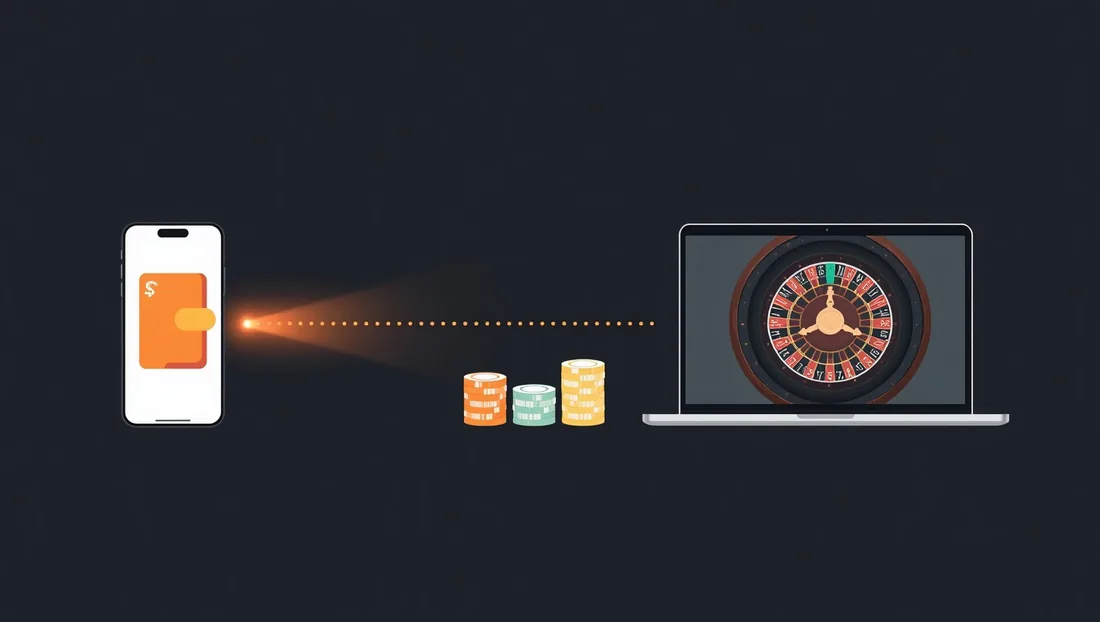
The crypto route goes from the exchange to the cashier in one hop. It is also the hop that cannot be undone if the network was chosen wrongly.
The route from kroner to crypto
If you take the crypto route, the deposit itself is the last of four steps. The three before it happen at an exchange, not at the casino:
- Open an account at an exchange that takes Danish kroner. Verification
here is thorough and happens once.
- Deposit kroner. A bank transfer is almost always cheaper than a card; the
difference is typically several per cent on the card against a small flat amount on the transfer.
- Buy a stable coin. USDT or USDC, unless you deliberately want a currency
position on top of the gambling.
- Send to the casino's deposit address, on the network the casino names.
Step four is the only one of the four that cannot be undone, and the mistake made most often is the network. The same USDT exists on several networks, and the casino credits only some of them. Copy the address, pick the network, and send a small test amount first if the operator is new to you.
The network fee is a flat amount, not a percentage
That is the detail that makes small deposits expensive. A fee of 20 kr. is nothing on 2,000 and ten per cent on 200. On a busy network the fee can exceed several rounds of play, which is why the choice of network belongs to the price and not to the technical details.
Out again
The way out is not simply the way in reversed. Most operators require the withdrawal to go by the same route as the deposit, and all of them put an approval before the transfer itself. What governs it is on withdrawals, and which papers have to be approved on the way is on verification.
Keep the cashier's history and your own transfers as you go. Those are the records you need if the winnings are taxable — see tax on winnings.
The one rule that saves the most
Decide the amount before you open the cashier. A cashier without MitID and without a Danish bank in the middle is fast in both directions, and speed is exactly what makes a bad evening more expensive than it needed to be. How to set a limit that holds is on play with care, and what a casino without a Danish licence otherwise changes about the account is in the same place as the rest of the differences.